
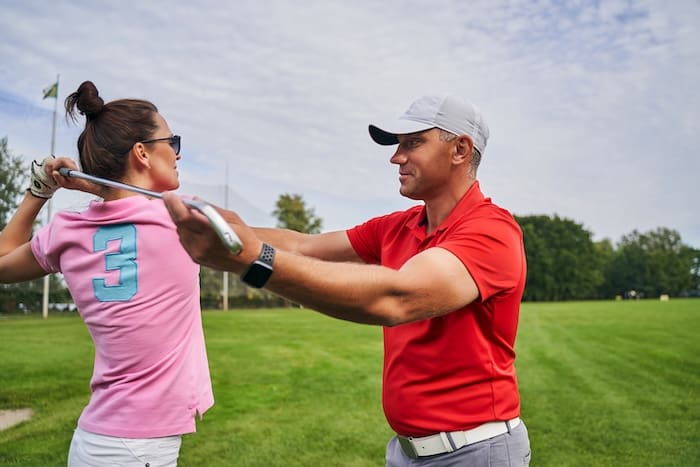
There is a golfer at every range in America who shows up twice a week, empties a large bucket with his driver, and shoots the same 94 he shot five years ago. Between the two of us we have taught more than 10,000 lessons, and we can tell you that player is not lazy. He practices more than most people he plays with. He simply practices in a way that cannot produce improvement, and nobody ever told him.
Getting better at golf follows the same rules as getting better at anything else. Find out specifically what is costing you. Work on it with real feedback. Give the change enough repetitions to survive pressure. The frustrating part is that almost everything golfers do by instinct breaks one of those three rules, which is why effort and improvement so often come apart in this game.
Below is the process we run with students, start to finish: scorecard audits, the practice structure, honest answers about lessons and timelines, and strokes you can save this weekend without changing a thing about your swing.
Start With Three Rounds and a Pencil
Before you change anything, you need evidence. Most golfers diagnose themselves by feel, and feel lies. The player convinced his driver is wrecking his rounds usually loses twice as many strokes inside 120 yards. He just remembers the drive into the trees more vividly than the three chips it took him to reach the green on the 14th.
For your next three rounds, track five things on the scorecard:
- Tee shots: in play or not, and which direction the misses went
- Greens: hit or missed, and whether each miss was short, long, left, or right
- Up and downs: every time you missed a green, did you get down in two?
- Putts per hole, with a circle around every three putt
- Disasters: penalty strokes, duffed or skulled shots inside 100 yards, and any hole that went double bogey or worse
Three rounds gives you 54 holes of evidence, enough for a pattern to show itself. When we run this exercise with new students, the results surprise them almost every time. The typical 90s shooter finds that approach shots left short, stubbed chips, and three putts from long range do the bulk of the damage. Driver distance, the thing most of them walked in wanting, rarely cracks the top three.
You cannot practice efficiently until you know where the strokes leave. Everything that follows assumes you have done this first.
Why You Are Not Getting Better at Golf
If you have practiced for years and your scores have not moved, one or more of these four habits is almost always the reason. We see them in nearly every stalled player who books a lesson.
You practice without a target or a consequence. Raking over another ball and hitting it at nothing teaches your brain that outcomes are free. On the course, every shot has an exact target and a price for missing it, so the skill built at the range never makes the trip. This one gap explains the golfer who flushes it on mats and falls apart on the first tee.
You chase distance before you own contact. Swinging harder with an unpredictable strike just spreads the misses wider. Until you can find the center of the face and control where the club bottoms out, added speed is borrowed trouble.
You change ideas every week. A tip from a video on Monday, a buddy’s advice on Thursday, a magazine drill on Saturday. A movement change needs about three weeks of consistent repetition before it feels normal. Stack three conflicting changes into that window and you keep none of them.
You practice what you are already good at. Your 7 iron feels great, so the 7 iron gets the reps. The wedge you chunk twice a round gets ignored, because practicing it is uncomfortable. Improvement lives in exactly that discomfort.
If any of those stung, good. All four are fixable, and none of them requires talent. They require structure.
Which Skills Lower Your Scores Fastest?
There is an order of operations to improvement, and getting it backward wastes entire seasons. From watching thousands of players progress, the sequence that moves scores soonest looks like this.
Strike comes first. Where the club meets the ball and where it meets the ground decide everything downstream. A player with solid contact and a slightly crooked swing beats a player with a pretty swing and random contact every single time. If your strike is unpredictable, no amount of short game or strategy work will hold together.
Then everything inside 100 yards. Counting putts, more than half the shots in an average round happen within wedge range of the hole, and this zone is where high handicaps bleed. A golfer who reliably gets a chip on the green and inside ten feet erases double bogeys at a rate no full swing change can match. The math is blunt: turning four blown chips into four ordinary ones saves more strokes than 20 extra yards off the tee ever will.
Then putting from three to eight feet. Long putts are mostly a speed skill, and lag speed sharpens quickly with practice. The short range is where rounds are decided. Most amateurs make far fewer six footers than they believe, and every miss in that window is a whole stroke gone with nothing to show for it.
Then the tee ball, and only for findability. The job off the tee is not distance. The job is playing your next shot from grass. Genuine distance gains come last, once the strike is stable, because speed stacked on poor contact collapses the first time pressure shows up.
How to Practice Golf So It Carries to the Course
The range and the course are different games unless you force them to overlap. A productive session has two halves: a learning block, where repetition and feedback build a movement, and a playing block, where the conditions are made to look like actual golf.
For the learning block, the strike line is the drill Thomas reaches for first. Draw a chalk line on the grass, or use a seam on the mat. Set the ball just ahead of the line. Your only goal is for the club to scuff the ground on the target side of the line, never behind it. Hit ten balls and count successes honestly. Most 90s shooters start around four out of ten. By the time you reach eight, your fat and thin shots are already disappearing, and you did not need a single swing thought to do it.
For the playing block, end every range visit with ten course balls. One ball, one shot, full routine. Picture the opening hole at your home course, hit the tee shot you would actually hit, then play the approach that result would leave, changing clubs on every swing and never repeating one. It feels harder than beating balls because it is harder, and that difficulty is the entire point. Skills built under varied conditions show up on Saturday morning. Skills built by raking balls stay at the range.
Around the green, play nine holes of up and down. Drop balls in nine different spots, a few clean lies, a few ugly ones, and play each into the hole. Par is two per hole, 18 total. Write the score down and chase it next week. The scorekeeping is not decoration. The moment a number attaches to practice, your brain starts treating those shots like real ones.
For putting, build a gate out of two tees barely wider than your putter head, three feet from a hole. Rolling balls through the gate trains a square face, and face control decides nearly everything from short range. Our standard for students is 20 in a row before we move on. It sounds tedious right up until you stop missing four footers.
How to Get Better at Golf at Home
Some of the fastest swing changes we have watched came from players who barely visited the range that month. They did slow repetitions at home instead, and the reason it works is simple: with no ball in front of you, your brain stops judging results and gives its full attention to the movement. When you are trying to change a pattern, the ball is mostly a distraction.
Ten slow motion swings a day, around quarter speed, will rebuild a motion faster than a hundred range balls. Pause at setup, at the top, and at impact, and check each position in a mirror or against a phone propped on a chair, face on one day, down the line the next. The mirror does not flatter and does not lie, which makes it a better coach than feel will ever be.
Grip changes happen at home or they do not happen at all. Take your new grip, check the knuckles, release, and repeat, 25 times while the TV runs. A changed grip feels wrong for about two weeks no matter who you are. The players who survive that window are the ones who built familiarity in the living room instead of fighting the discomfort mid round.
Roll putts through the tee gate on carpet. Carpet speed is irrelevant. Face control is the skill, and it transfers completely.
None of it requires a net or a launch monitor. A club, a mirror, and ten minutes covers the whole program, and ten daily minutes beats two hours on Saturday for movement change every time. Frequency teaches the body. Volume just tires it.
How to Get Better at Golf in the Winter
Golfers in cold climates treat the off season as dead time. The clubs go in the garage in November, and the player who emerges in April spends six weeks rediscovering whatever he had in September. It is the most common improvement leak in northern golf, and it runs in exactly the wrong direction.
Winter is when meaningful swing changes get made. No scorecard, no Saturday group watching, no temptation to abandon a change because it cost you two strokes on the weekend. Tour players rebuild in the off season for precisely these reasons. Twelve to sixteen weeks of pattern work without consequences is a gift, and a simulator turns that gift into a laboratory. Launch monitor data shows strike location, face angle, and path on every single swing, feedback a grass range cannot give you even in July.
Our students across Chicago’s western and southwest suburbs train straight through the winter, and the gap each spring is not subtle. The golfer who puts in one structured indoor session a week from December through March comes out playing his August golf in April while everyone else thaws. We coach year round indoors in Downers Grove, Naperville, and Palos Heights, and the winter calendar fills with players from Orland Park to Wheaton who have figured this out. Wherever you live, if your season dies in the fall, find a simulator and make the cold months your building phase.
Do Golf Lessons Actually Help?
We teach golf for a living, so weigh our answer however you like, but you will get it straight, including the part that costs us money.
Lessons help enormously in specific situations. If your contact is unpredictable, a trained eye finds the cause in minutes that you might chase alone for years. If a slice or hook has survived everything you have thrown at it, the real fix is almost never the one you have been attempting, because ball flight causes run counter to intuition and self diagnosis tends to treat the symptom. If you are brand new, a handful of early lessons is the cheapest insurance in the game, since habits formed in the first few months take roughly ten times the effort to remove later. And if your scores have not moved in two seasons or more, an outside diagnosis is worth more than another year of guessing.
Lessons disappoint in one situation above all others: when nothing happens between them. A lesson identifies the change and hands you the drill. The improvement itself happens afterward, in repetitions, on your own time. A student who takes one lesson and practices the assignment three times will outrun a student who takes four lessons and practices never. We have watched both versions play out hundreds of times and it is not close. You get better between lessons, not during them.
Can You Get Better at Golf Without Lessons?
Yes, with honest conditions attached. You need a camera, because feel and reality drift far apart and video is the only affordable referee. You need the discipline to work one change at a time for at least three weeks. You need to prioritize contact and short game even though driver content is more entertaining to study. And you need to accept that trial and error has a cost, sometimes a steep one, because without a diagnosis you can spend a month repairing something that was never broken. Plenty of self taught players reach the mid 80s this way. What they trade is almost always speed, not the ceiling.
How Many Golf Lessons Do You Need?
Fewer than most people assume, spaced further apart than most people book them.
A brand new player gets the most out of three to five lessons across the first couple of months, covering setup, contact, and basic short game, then a check in every month or so. An established player with one stubborn problem usually needs a full swing consultation plus two to four focused sessions, spaced two to three weeks apart so each change has room to take root. A player whose game is in decent shape needs nothing beyond a tune up every four to eight weeks, enough to catch drift before it hardens into habit.
What almost nobody needs is a weekly lesson. Back to back sessions pile fresh information onto a change that has not settled, and the student ends up rehearsing confusion. When someone asks us to book weekly, we usually talk them into every other week with practice assignments in the gap. They improve faster and spend less. The spacing is not a compromise. The spacing is the method.
How Long Does It Take to Get Better at Golf?
Honest timelines, from watching this play out across thousands of students.
A movement change starts feeling normal after two to three weeks of frequent, short repetitions. It holds up on the course, under pressure, with a card in your pocket, somewhere around six to eight weeks. Scores follow on their own schedule after that. A player shooting 95 to 100 who puts in two or three structured hours a week very commonly reaches the upper 80s inside three to six months. Faster happens, usually when the root problem turned out to be setup. Slower happens too, usually when the practice was sporadic.
Two warnings about the middle of that timeline. First, you will often play worse before you play better, because the old motion was at least familiar and the new one is not yet automatic. That dip scares golfers into quitting a change about two weeks before it pays off. Second, progress arrives in steps, not slopes. You will plateau, sometimes for weeks at a stretch, and as Jack tells students, a plateau is consolidation, not failure. Every player we have moved from the 90s into the 80s walked through at least one stretch where nothing appeared to be happening.
Is It Too Late to Get Good at Golf?
Some version of this question comes from every student over 45, and the honest answer is that golf skill carries no expiration date. Swing speed peaks young. Scoring does not. Contact, wedge play, putting, and decision making remain fully learnable at any age, and adult students bring two advantages juniors rarely have: they follow structure, and they actually do the homework. Some of the most satisfying turnarounds in our lesson book belong to players who took the game up after 50 and broke 90 within two seasons, hitting it 210 off the tee and tidying up everything inside 100 yards. The tees move forward. The skills never ask your age.
Drop Strokes This Weekend Without Changing Your Swing
Decision strokes are free, and most golfers donate a handful every round. These four adjustments cost nothing and require zero practice.
Take one more club into every green. Amateurs miss short far more often than long, largely because everyone clubs for their best strike instead of their average one. Pin high with a smooth swing beats short and tense every day of the week.
Aim at the middle of the green and putt out to the pin. A flag tucked behind a bunker is a sucker bet at every handicap above scratch. Center of the green all day turns your bad ball striking rounds into 35 putts instead of three lost balls.
Off the tee, pick the club that removes the big number, not the one that maximizes the small one. When driver brings trees, water, or out of bounds into the picture, a hybrid in the fairway leaves a comfortable wedge and no path to a triple. Run the numbers on any tight par 4 and the shorter club wins.
From tight lies just off the green, pull the putter. A mediocre putt from the fringe finishes closer than a mediocre chip for nearly every player we have ever tested, and the disaster outcome vanishes entirely.
One last piece of scoring perspective. Bogey golf is a 90 on a par 72, so a single par in the mix breaks it. You do not need birdies to reach the 80s. You need to stop converting bogeys into triples, and the four habits above are how that happens.
Your First Four Weeks
If you want a structure to start from, run this and adjust as the evidence comes in.
Week one, change nothing. Play or track two rounds with the pencil audit, and begin the daily home routine: ten slow swings and 20 gate putts.
Week two, add one range session built the way described above, strike line first, ten course balls to close. Keep the home reps alive.
Week three, make it a short game week. Play par 18 around a practice green twice, record both scores, and keep one range session.
Week four, play a round applying the four decision rules, track it, and set the numbers next to week one. The categories that moved tell you what to keep doing. The ones that refused to move show you where you need another set of eyes.
From there, the cycle repeats with a sharper focus each month. If the audit keeps pointing at contact you cannot crack on your own, that is the moment a one on one lesson earns back its cost many times over. For golfers around Chicago’s west and southwest suburbs, that is what we do all year, indoors straight through the winter. For everyone else, the plan above does not need us. It needs three rounds, a pencil, and three honest weeks.